
HIRING RESEARCH
A Friendly Interview Is Not a Scorecard: How Structured Questions Work
An interview can feel formal and still give you a fair chance to show your work. Understanding what is being assessed helps you prepare evidence instead of guessing the interviewer's favourite answer.
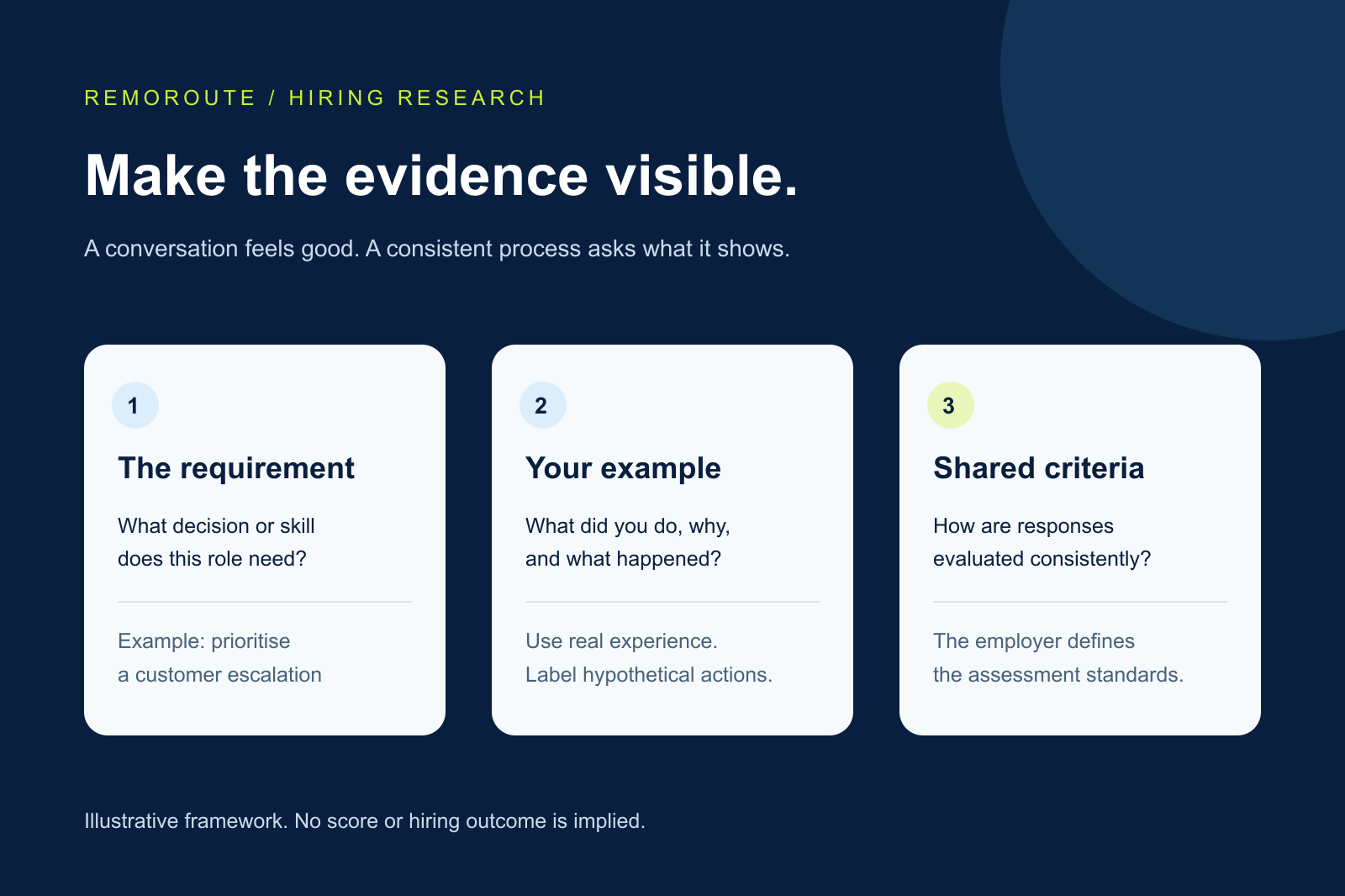
Rapport and evidence answer different questions
You finish a video interview smiling because the conversation flowed. That is pleasant, but it does not reveal how the hiring decision will be made. Another interview feels quieter: the panel asks a prepared question, takes notes and moves on. The second experience need not mean the panel dislikes you. It may be following a consistent assessment process.
For a candidate, the useful distinction is between the social experience and the evidence you provided about the work. Both matter, but neither lets you predict an offer. This article looks at the structure of the assessment, complementing our preparation guide rather than offering a script to memorise.
What makes an interview structured
The U.S. Office of Personnel Management describes structured interviews as systematic questions about relevant past behaviour or proposed behaviour in a hypothetical situation. Its model uses predetermined questions and common standards for evaluating responses. The point is to compare evidence against requirements more consistently.
CIPD guidance likewise recommends predefined questions and agreed scoring criteria, with interviewers forming independent assessments before discussion. It also stresses preparation and the use of other appropriate evidence. A panel, a video platform or a numbered list of questions does not by itself establish that a process has these features.
OPM: what structured interviews assess →CIPD: selection methods and consistent assessment →
Prepare a small set of examples you can explain
Start with the job description and identify the decisions the role will require: prioritising a queue, checking data, handling a disagreement or diagnosing a failure. For each, choose a real example in which your own contribution is clear. Note the situation, what you were responsible for, what you did and what happened.
Then add the detail that polished scripts often omit: why you chose that action, what information was missing and what you would change next time. If a result was measured, use the real measure. If it was not, explain the observable outcome without inventing a percentage. A modest example you can discuss is more useful than a dramatic story that collapses under a follow-up question.
Prepare for remote interviews and assessments →Choose evidence that supports your claims →
A hypothetical question calls for reasoning, not fictional experience
Suppose an interviewer asks how you would handle a customer escalation when the responsible engineer is offline. You can explain how you would assess urgency, identify an approved escalation route, communicate uncertainty and document the handoff. Those are proposed actions, not an achievement you have already delivered.
Make that distinction explicit. If you have a related real example, explain how it informs your approach and where the new situation differs. Ask a brief clarifying question when a missing constraint changes the answer. Do not turn a hypothetical scenario into an invented job history simply because the interview feels competitive.
Ask about the process without requesting an answer key
A reasonable preparation message can ask which skills the stage will assess, whether examples or a work demonstration are expected, how much time is available and which tools are permitted. An employer may not disclose its precise questions or scoring rubric. That does not prevent it from explaining the format.
If you need an accessibility adjustment, use the employer's stated route early. If a test includes confidential material or an unfamiliar tool installation, resolve that separately before beginning. A well-organised interview does not remove the need to verify who is recruiting and what information you are being asked to provide.
Make a clear interview-adjustment request →Clarify assessment data and tool use →
Use the structure to make your evidence easier to judge
After an interview, write down which competencies were explored and which examples you used. If feedback is available, ask about the requirement or evidence that needs strengthening. An outcome alone cannot tell you whether the process was valid, whether another candidate had closer experience or whether the role changed.
Structured methods can improve consistency, but their quality still depends on the relevance of the questions, the standards and how people use them. OPM and CIPD describe sound assessment practice; they do not guarantee a particular employer follows it or that a prepared candidate will be hired. Your practical goal is to leave clear, truthful evidence that answers the question asked.
- Match each example to an actual role requirement.
- Explain your contribution and decision, not just the team's result.
- Label hypothetical reasoning clearly.
- Clarify format, time and allowed tools in advance.
- Use feedback about evidence to improve the next attempt.
Follow RemoRoute
Choose the updates that suit you.
Use Telegram for fast role updates and LinkedIn for research, practical articles and selected opportunities.