
REMOTE WORK RESEARCH
Before Joining a Remote Team, Ask How You Will Meet the Rest of the Company
Knowing your manager is not the same as knowing how the organisation works. Research on communication networks offers a better interview question than simply asking how many days people spend in the office.
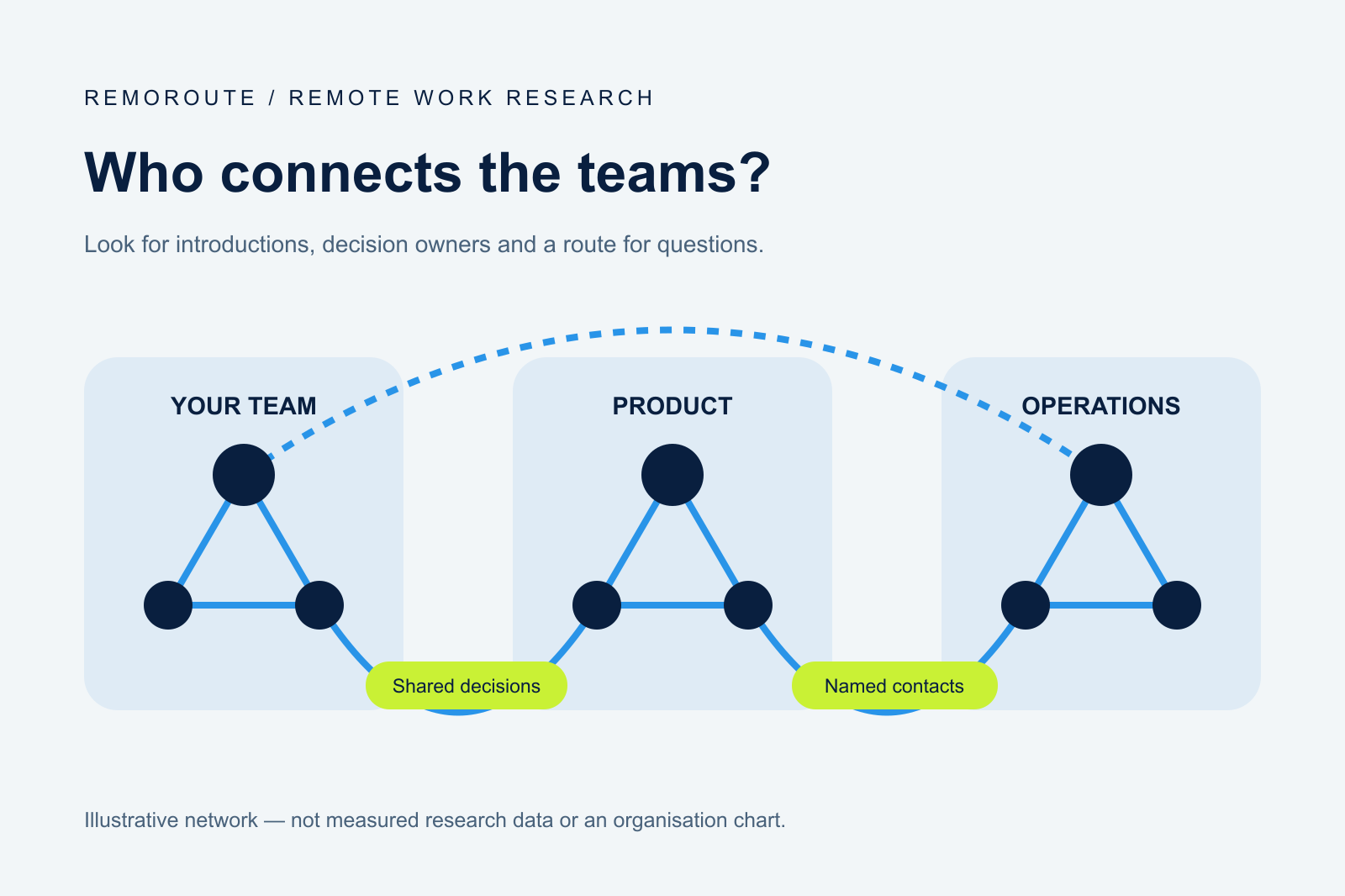
The remote-work question hidden behind the meeting calendar
An employer can show you a full calendar and still leave you unsure whom to ask when a problem crosses team boundaries. Your manager may be supportive, while access to product, operations or finance depends on introductions nobody has arranged. For a new joiner, that gap can make ordinary work unexpectedly difficult.
The practical question is how a person gets useful context beyond their immediate group. This is different from an argument about whether remote work is universally better or worse. It asks what a particular team does to make knowledge and people reachable.
What the Microsoft communication study found
Research published in Nature Human Behaviour in 2021 examined communication patterns around Microsoft's shift to company-wide remote work. Comparing workers with different prior remote arrangements, the authors estimated that collaboration networks became more siloed and less dynamic. The share of collaboration time involving cross-group connections fell by about 25% relative to its pre-pandemic level.
That is a change in a network measure, not a 25% fall in productivity or an estimate of your own career prospects. The study concerned one organisation during a major pandemic transition. Its comparison strategy attempts to separate remote-working effects from other changes, but it cannot describe every remote company or later working practice.
A second setting points to bridges between groups
A 2022 Nature Computational Science study examined the email network of 2,834 MIT researchers around changes in physical co-location. It found a reduction in weak connections during the remote period and examined how their formation related to proximity. This was an institutional research setting, with email connections as an observable trace of interaction.
An email link is not a direct measurement of creativity, friendship or the quality of every conversation. Together, the two studies support a practical concern about how information travels between groups; they do not establish that putting everyone in an office automatically solves it. That leaves room to examine the actual arrangements a prospective employer has built.
The effect of co-location on human communication networks, 2022 →
Ask for a recent example of cross-team work
Instead of asking whether the culture is collaborative, try: “When someone new needs a decision from another team, how do they find the right person?” Follow with a request for an ordinary recent example. Look for an explanation of ownership, introductions and where decisions can be found.
A hypothetical customer-support scenario can make this concrete. If a recurring ticket suggests a product defect, who triages it, what information does support provide, and where does the eventual decision return? You are assessing whether there is a usable path through the organisation, not demanding access to private customer records or internal discussions during an interview.
Look for access that does not depend on constant availability
An introduction is useful only if you can continue working afterwards. Ask how a new employee learns the organisation's vocabulary, where decisions are recorded and who covers a dependency when the normal contact is unavailable. If the team spans time zones, ask how a question gets an owner without expecting everybody to stay online.
These are editorial decision prompts, not interventions tested by either study. A shared project briefing, a named onboarding contact or an open question channel might help in a particular organisation, but their value depends on whether people use them. A screenshot of many channels or a promise of frequent socials is less informative than an example of a real question reaching a responsible person.
Clarify overlap hours and response expectations →Prepare for your first week →
Turn the conversation into a joining decision
Before accepting, note the people and processes your role will depend on. Separate what the employer demonstrated from what is still a promise. If you will own an outcome but cannot identify an escalation route or decision-maker, ask for clarification before treating the arrangement as settled.
Useful connections after joining are not the same thing as external networking to find a vacancy. They help you understand and perform the work you have agreed to do. The research offers a reason to ask about those bridges; the employer's concrete answers help you assess whether this particular role gives you access to them.
- Who introduces new joiners to the teams they rely on?
- Where are cross-team decisions and owners recorded?
- How does a question travel when the usual contact is offline?
- What recent example shows the process working?
- Which unanswered dependency should be clarified before acceptance?
Assess the full role fit →Explore listed remote opportunities →
Follow RemoRoute
Choose the updates that suit you.
Use Telegram for fast role updates and LinkedIn for research, practical articles and selected opportunities.