JOB SEARCH RESEARCH
Should You Search for a Different Job Title? What Two Experiments Tell Us
A job-search tool suggests a career you have never considered. That could be useful information, or another distraction. The difference starts with the evidence behind the suggestion.
A quiet inbox does not identify the cause
When applications produce little response, it is tempting to make one sweeping diagnosis: the CV is wrong, the profession is disappearing, or the search needs twice as many applications. None follows from silence alone. A posting may have closed, the location may be ineligible, or the same title may describe very different work at different employers.
A more useful question is whether your search terms exclude work you can already do. Occupational labels are a starting point, not a complete inventory of your abilities. Someone who reconciles invoices, investigates exceptions and maintains accurate records may find relevant tasks under several titles. That does not make them qualified for every accounting or operations job; it gives them specific alternatives to investigate.
One experiment found benefits from targeted alternatives
A May 2025 NBER working paper by Belot and colleagues studied unemployed job seekers searching in occupations with relatively few vacancies per job seeker. A randomised field experiment provided suggestions for suitable alternative occupations and information comparing their prospects. The authors report improvements of roughly 5–6% in employment, hours and labour income after 18 months for the group in structurally weak occupational markets.
The setting matters: this was a targeted intervention in the Netherlands, not a trial of every job board or an estimate of what any individual can gain by changing a search term. The lesson is narrower and more useful. Advice can help when it connects a person's situation to plausible alternatives and actual demand. It is not evidence that every career pivot pays off.
A much larger platform experiment found no employment effect
A different NBER working paper, published in April 2022, evaluated encouragement to use an online advice platform with the French public employment agency. The experiment covered 212,277 people. The authors found some changes in search methods but no effect on employment outcomes over the 18-month follow-up.
These findings are not a competition between two countries or proof that one platform is universally better. The interventions, target groups and contexts differed. Together they show why “personalised advice” is not an outcome in itself. Opening a recommendation, adopting a tip and obtaining suitable work are separate events. A product demonstration cannot stand in for the last one.
Ben Dhia et al.: online job-search assistance experiment, 2022 →
Translate tasks before translating titles
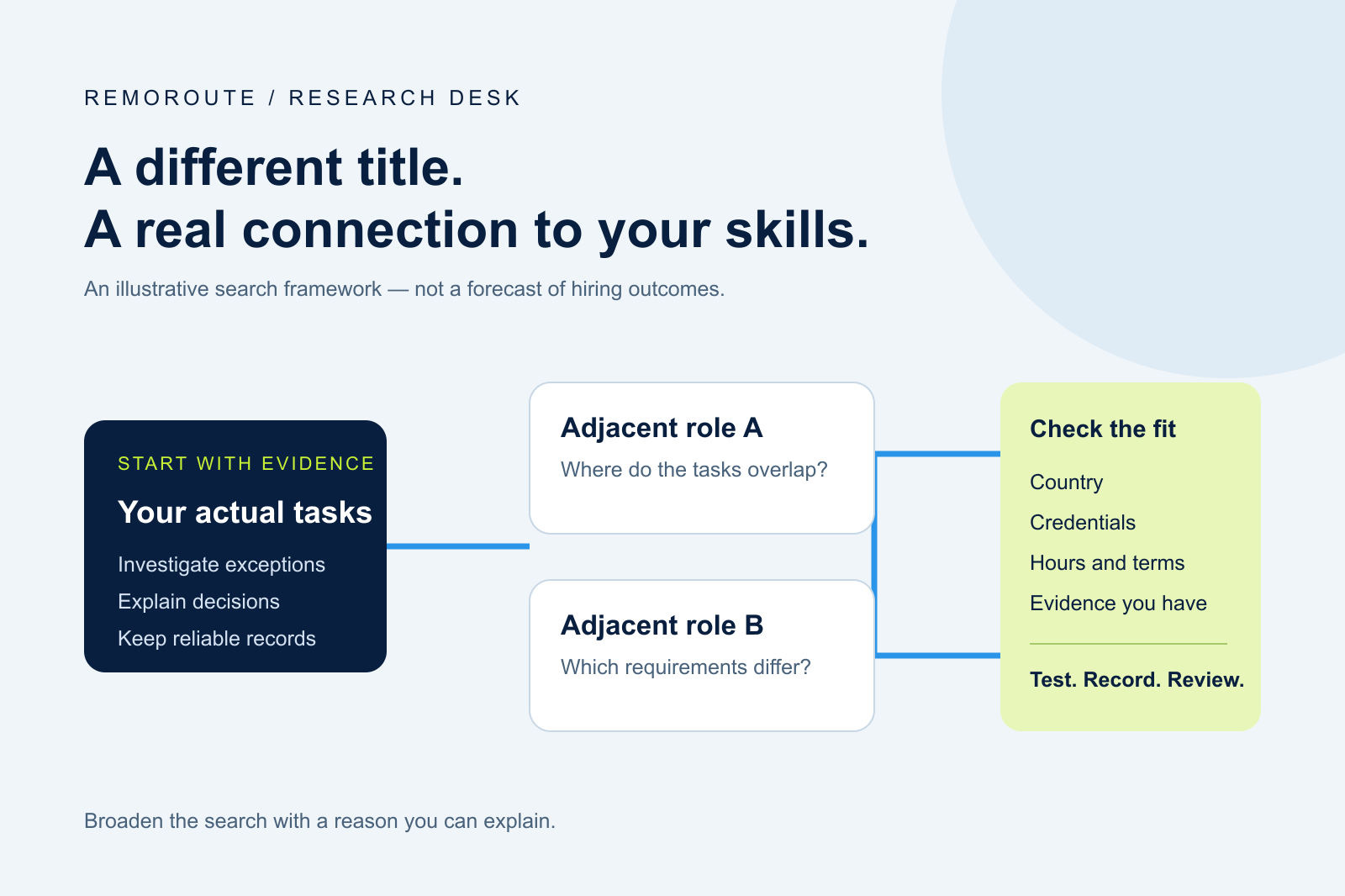
Try this editorial exercise: write five tasks you can explain from your own experience, with one example for each. Then examine a small set of adjacent roles and mark which requirements you already meet, which you could demonstrate with a short practice exercise, and which require a credential or substantial experience you do not have. Do not convert familiarity into a claimed qualification.
For example, a customer-support professional who analyses recurring tickets might explore support operations. They should still check whether the role requires SQL, workforce planning or ownership of reporting systems. The task overlap opens a question; it does not answer it. Keep the evidence you can show separate from the skills you intend to learn.
Build evidence for a transferable skill →Check whether the role is actually a fit →
Protect the constraints that a recommendation may ignore
An occupation can have strong demand while a particular vacancy remains unsuitable. Check the allowed work country, language, hours, professional registration, engagement type and application route before investing in a tailored submission. A remote label does not remove these conditions.
Also distinguish an adjacent role from a training sale or an open-ended talent pool. Ask what specific work is available and what evidence makes the recommendation relevant to you. A promised hiring outcome should not be the reason to pay for access, reveal sensitive documents or rewrite your experience.
Run a small comparison, then review it
For your next search cycle, keep your main target and add one carefully chosen adjacent role. Use comparable, eligible vacancies and record the title, the real tasks, the reason you fit, the submission date and the next stage. Review what you learned after enough time for the employers' stated process. This is a personal decision aid, not a controlled experiment or a guaranteed route to an offer.
If an alternative keeps requiring a qualification you lack, narrow it or choose another. If you can explain the match and receive relevant conversations, investigate further. The aim is to improve the quality of the search decisions you control, without treating every unanswered application as a verdict on your potential.
- List tasks and examples from real experience.
- Choose one adjacent occupation to investigate.
- Check eligibility and any mandatory credentials.
- Track appropriate applications and actual next stages.
- Review the fit before expanding the search further.
Follow RemoRoute
Choose the updates that suit you.
Use Telegram for fast role updates and LinkedIn for research, practical articles and selected opportunities.